
Solutions for dilutions: A practical guide for lab techs.
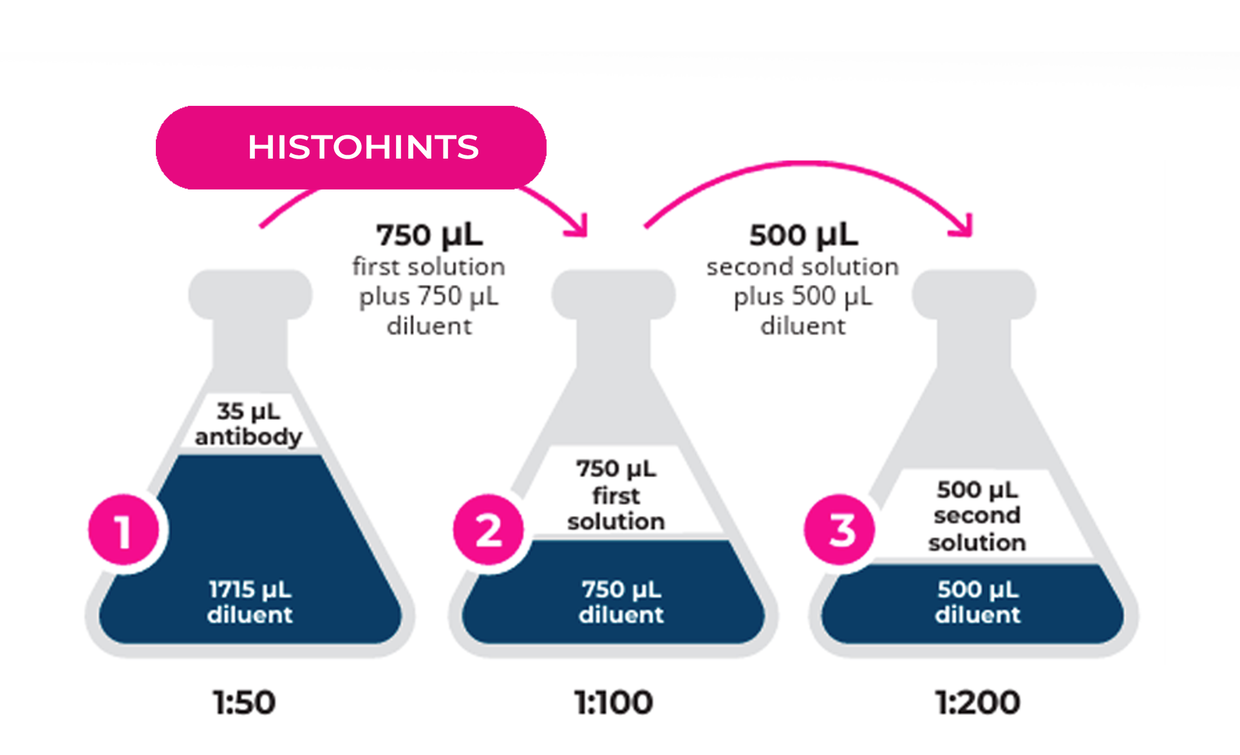
Whether you're preparing reagents and antibodies or running assays, mastering dilutions is essential for accuracy and reproducibility in the lab. This printable guide breaks down the most common types of dilutions—standard, serial, and unit conversions—with examples and tips to make your workflow smoother.
DOWNLOAD AND PRINT THE SOLUTIONS FOR DILUTIONS GUIDE
Common dilutions used:
- Standard dilutions: These are typically used when preparing stains or antibodies from concentrate stock solutions.
- Serial Dilutions: Ideal for determining optimal antibody concentrations, serial dilutions involve creating a series of step dilutions to test a range of concentrations. This method is especially useful in titration experiments.
- Everyday Conversions: From volume and length to mass and temperature, conversions are used daily to keep tests running smoothly in the lab.
Tips for accurate dilutions:
- Always use calibrated pipettes and volumetric flasks.
- Mix thoroughly after each dilution step.
- Label clearly to avoid mix-ups.
- Double-check calculations – especially for serial dilutions.
Recent Posts
-
StatClick Prefill Handling and Closure
How to properly handle and close the StatClick Prefill for leak-proof transport. Follow your facili
-

Silver stains start here: clean glassware.
We’ve all had that glassware that looks clean—but silver stains can tell a different story. Tiny tra
-
Color Matters: 10 tips for getting the most from Tissue Marking Dyes.
Tissue Marking Dyes may seem like a simple part of the grossing workflow, but small handling habits